
You’ve invested millions into your fleet. The haul trucks are running. The shovels are swinging. On paper, everything looks productive. But here’s the uncomfortable truth most mining operations quietly live with — your equipment is probably performing far below its actual potential, and your operators might not even realize it.
Overall Equipment Effectiveness, or OEE, is a metric borrowed from manufacturing that has found a surprisingly natural home in mining. It distills the messy reality of equipment performance into three deceptively simple numbers: availability, performance, and quality. Multiply them together, and you get a single percentage that tells you how much of your planned production time is genuinely productive.
The global benchmark for world-class OEE sits around 85%. Most mining operations? They hover somewhere between 25% and 55%, depending on who you ask and which fleet you measure. That gap is not just a number on a spreadsheet. It translates directly into lost tonnage, wasted fuel, inflated maintenance budgets, and missed production targets that compound quarter after quarter.
So what’s going wrong? And more importantly, why aren’t traditional training programs catching these blind spots?
Availability: The Silent Killer Nobody Talks About
Availability measures something deceptively straightforward: how much of your planned production time is the equipment actually operational? Every unplanned breakdown, every extended changeover, every minute a truck sits idle waiting for a part — it all chips away at this number.
In most open-pit operations, availability losses account for the largest share of OEE degradation. Equipment failures, delayed maintenance windows, and material shortages create cascading bottlenecks that ripple across the entire fleet. A single shovel going down unexpectedly doesn’t just affect one piece of equipment — it disrupts the loading cycle, backs up haul trucks, and throws the dispatch sequence into chaos.
The tricky part? Most operators are never exposed to these failure scenarios during training. Classroom sessions cover maintenance checklists and standard operating procedures, but they rarely simulate what it actually feels like when a hydraulic line blows mid-shift, or when a tire blowout forces an emergency reroute. The cognitive load of making split-second decisions under pressure is something you can only develop through experience — or through immersive simulation.
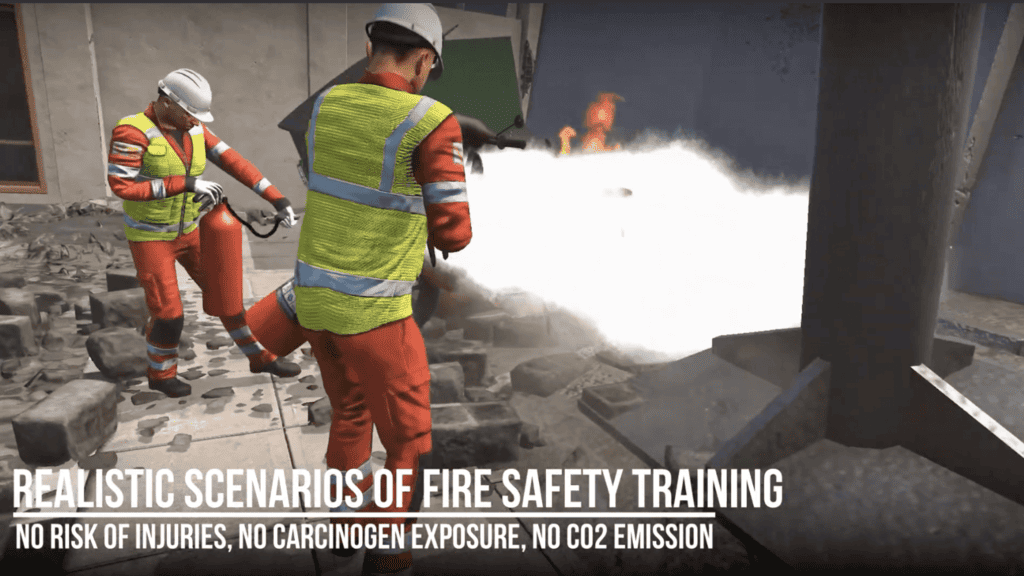
This is where VR fundamentally changes the equation. Inside a virtual replica of the mine site, operators can encounter equipment failures, practice diagnostic sequences, and rehearse emergency protocols without putting a single piece of real machinery at risk. Virtu, an Indonesian immersive technology company, has been building exactly these kinds of training environments — custom-built VR simulations that replicate specific equipment models, site layouts, and failure scenarios tailored to each client’s operational reality.
The result isn’t just better-prepared operators. It’s a measurable reduction in mean time to repair, fewer cascading failures, and availability numbers that start climbing toward where they should be.
Performance: Running, But Running Right?
Here’s something that frustrates mine planners everywhere: the equipment is technically running, but it’s not running at the speed it should be. Performance measures actual output against theoretical maximum capacity, and the gap between those two numbers is often wider than anyone wants to admit.
Slow cycle times, unnecessary idle periods, suboptimal gear selection on haul roads, poor loading technique — these are the quiet inefficiencies that don’t trigger any alarms but steadily erode your throughput. A haul truck that consistently runs 8% below optimal speed across a 12-hour shift doesn’t just lose 8% of its capacity. The compounding effect across an entire fleet and an entire quarter adds up to staggering volumes of unmoved material.
Traditional training addresses performance in theory. Operators learn the recommended speeds, the ideal bucket fill factors, the textbook approach to ramp navigation. But knowing something intellectually and executing it instinctively under real operating conditions are two very different things.
VR training bridges that gap by putting operators inside the cab of a virtual haul truck on a virtual haul road that mirrors their actual route — complete with gradients, curves, traffic patterns, and weather conditions. Every action is tracked with granular precision. Gear changes, braking patterns, speed consistency through corners, approach angles at the loading face — all of it gets recorded, analyzed, and fed back to the trainee in real time.
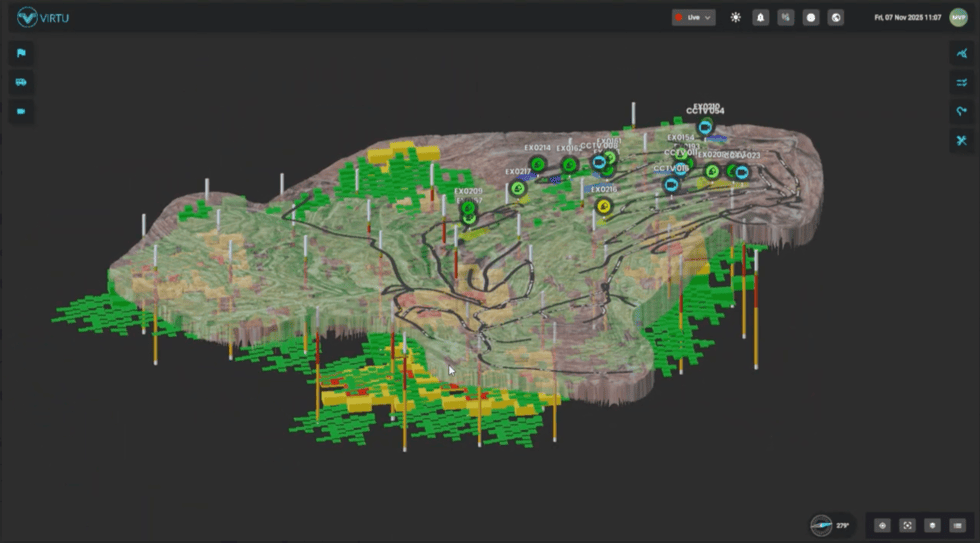
Virtu’s approach to mining VR simulation takes this a step further by integrating digital twin data from actual mine sites. Instead of training on a generic virtual environment, operators practice on a virtual copy of their own workplace. The topology matches. The road conditions match. Even the traffic flow patterns reflect real operational data. This level of specificity means the skills developed in VR transfer directly to the field with minimal adjustment.
When performance improvements of even 3% to 5% are applied across an entire truck fleet running around the clock, the production gains are substantial — and they start showing up in the very first month.
Quality: The One Everyone Overlooks
In manufacturing, quality is intuitive — it’s the ratio of good products to total products. In mining, the concept translates differently, and that translation is where most operations lose the plot.
Quality in a mining OEE context captures losses from rework, material contamination, ore dilution, incorrect blast fragmentation, and any output that doesn’t meet the downstream processing specifications. A truck that delivers a load to the wrong dump point creates a quality loss. An operator who consistently overloads or underloads the bucket introduces variability that cascades into processing inefficiency. A drill pattern executed at the wrong angle compromises fragmentation quality and increases crusher energy consumption.
These are not dramatic failures. Nobody sounds an alarm. But they represent a persistent, low-grade drag on the entire value chain that most training programs simply don’t address.
Why? Because replicating quality-impacting scenarios in a real mine environment is logistically impossible. You can’t intentionally drill a bad pattern to show trainees what happens downstream. You can’t deliberately send a truck to the wrong location to illustrate the consequences. The feedback loop between an operator’s action and its quality impact is often delayed by hours or days, making it invisible during conventional training.
VR collapses that feedback loop entirely. In a simulated environment, you can fast-forward the consequences. An operator makes a suboptimal loading decision, and within seconds, they see the downstream impact — the increased processing time, the higher energy consumption, the tonnage shortfall. That immediate cause-and-effect connection builds intuitive understanding in a way that no classroom lecture ever could.
Virtu has been pioneering this approach in Indonesia’s mining sector, working with operations that need their workforce to understand not just what to do, but why precision matters at every stage. Their VR training platforms track operator decisions at a granular level, scoring not just whether a task was completed but how it was completed — and what the quality implications would be in a real production environment.

Why These Gaps Persist — And What Changes Now
The uncomfortable reality is that most mining operations know their OEE is below benchmark. The data is there. The dashboards exist. The problem isn’t measurement — it’s the inability to translate measurement into behavioral change at the operator level.
Classroom training can teach the theory. On-the-job mentoring can develop experience over time. But neither can safely replicate the high-stakes, high-consequence scenarios that separate a competent operator from an exceptional one. Neither can compress years of situational exposure into weeks of targeted practice. And neither can provide the kind of precise, data-driven feedback that identifies exactly where each individual operator’s OEE contribution falls short.
VR training is not a replacement for field experience. It’s an accelerant. It takes what would normally require months of on-site exposure and condenses it into repeatable, measurable, customizable simulation sessions that target the specific behaviors driving availability, performance, and quality losses.
For mining companies operating in Southeast Asia and beyond, Virtu represents a partner that understands both the technology and the operational context. Their work with Indonesian mining operations — building digital twin environments, developing custom VR training modules, and integrating immersive simulation into existing workforce development programs — demonstrates what becomes possible when training technology is designed around real operational challenges rather than generic scenarios.
The three OEE metrics aren’t just numbers to track. They’re behaviors to train. And the mining operations that figure out how to train those behaviors effectively — in a safe, scalable, and measurable way — are the ones that will pull ahead.
Start Closing the Gap
If your operation is measuring OEE but struggling to move the needle, the bottleneck might not be your equipment or your processes. It might be the gap between what your operators know and what they instinctively do under pressure.
Explore how Virtu’s VR training solutions can help your mining workforce master all three pillars of OEE — not just in theory, but in practice. Visit virtu.co.id to learn more about custom immersive training built for the mining industry.
Contact Us
Call / WhatsApp: +62 812 9696 7887
Email: [email protected]
Website: www.virtu.co.id