The Gap Technical Training Doesn’t Cover
First-aid courses are built almost entirely around technical competence — correct technique, correct sequence, correct decision-making. All of that is necessary. None of it fully prepares someone for the specific psychological weight of actually being the first person to reach someone who’s seriously hurt, which is a different kind of pressure than executing a memorized procedure in a calm classroom.
That gap shows up in a specific, well-documented way: people who are technically certified in first aid sometimes still freeze, hesitate, or perform worse than their training would predict, purely because the emotional intensity of a real situation is something classroom certification never actually exposed them to.
Building Exposure Before the Real Moment
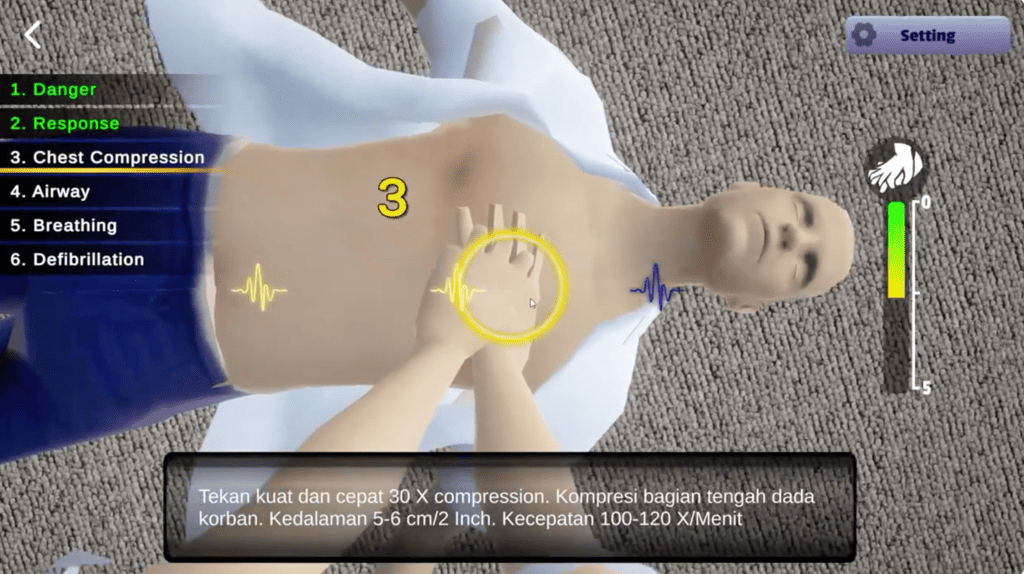
As a leading provider of immersive VR training solutions, VGLANT’s first-aid scenarios are deliberately built with enough visual and situational realism to create some of that emotional weight during training itself — not to distress trainees unnecessarily, but to make sure the first time someone experiences the intensity of a real casualty isn’t also the first time they’re expected to perform under it.
Repeated exposure, even in a simulated form, tends to reduce that freeze response over time. A trainee’s second and third run through a realistic scenario typically shows measurably less hesitation than their first, which suggests the psychological adjustment is happening — the kind of adjustment that used to only occur after someone had already been through a real emergency, sometimes at real cost to their performance the first time.
What This Adds to a Training Program
Session data tracks hesitation and composure indicators alongside technical performance, giving a more complete picture of readiness than technical accuracy alone. A trainee who performs the correct technique but takes noticeably longer to initiate it each time may need more exposure before being considered fully prepared, even if their technical knowledge tests well.
A More Honest Definition of Readiness
Transforming first-aid training with cutting-edge virtual reality technology means treating psychological readiness as part of the actual competency being trained, not a separate concern left entirely to chance in the field.
Learn more about VGLANT’s approach to first-aid readiness at vglant.com.