
The ultimate test of any safety program isn’t a passed quiz—it’s whether a worker can actually kill a fire when the alarms go off. This is the “knowledge retention” problem. For over a century, the Ebbinghaus “forgetting curve” has haunted corporate training; humans dump roughly 70% of new data within 24 hours. By the time an annual fire drill rolls around, most employees retain less than 10% of what they learned 12 months prior.
For high-risk sectors like mining and energy, this decay isn’t just a compliance issue—it’s a massive operational risk. VGLANT and the wider Virtu network are now pivoting toward Virtual Reality (VR) to flatten this curve, using the mechanics of cognitive science to make training “stick.”
The Neurobiology of Why VR Works
Why does a headset outperform a classroom? It’s not about the “cool factor”—it’s about how the brain encodes procedural memory.
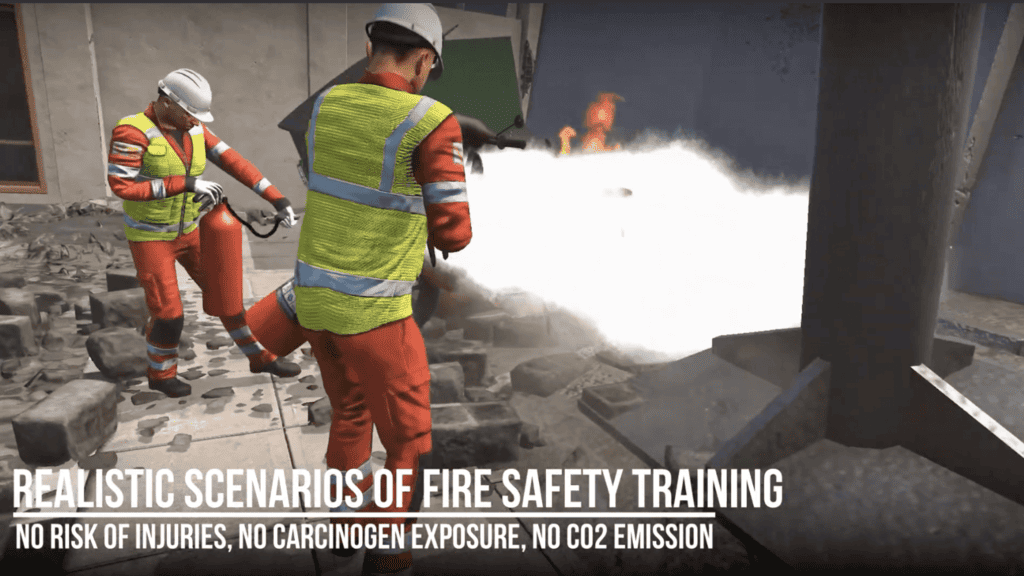
- Embodied Cognition: VGLANT doesn’t ask you to watch a video; it asks you to move. Participants physically grab the Tube VR Control Set, aim at the base of the digital blaze, and execute the PASS technique. This motor engagement creates “procedural” memory traces in the brain that are far more durable than the “declarative” memories formed by listening to a lecture.
- The Amygdala Factor: Research shows that memories tied to emotional arousal are stickier. VR fire simulations create a controlled “stress response”—increased heart rate and a sense of urgency—without the actual danger. This moderate stress encodes the memory more deeply, leading to much higher recall at the 30-day mark.
- Active Generation: In a VGLANT scenario, you aren’t a spectator. You have to independently judge the fire class and choose the right APAR (Extinguisher). Each choice is an “active generation event.” Your brain works harder to retrieve the correct action, which ironically makes it easier to remember later.
Hard Data: The Industrial Reality
The theory is backed by increasingly solid empirical evidence. A 2022 meta-analysis across 42 studies showed that VR training provides a 33% retention advantage over traditional methods, particularly in procedural skills like fire suppression.
On the ground in Southeast Asia, the results are even more focused. Companies within the Virtu industrial network have seen post-training assessment scores jump significantly. Organizations utilizing the VGLANT platform report that employees score about 23% higher on practical rubrics compared to those who only received classroom instruction.
In the mining sector, the win is repetition volume. You can’t let a worker discharge 50 real extinguishers in a single afternoon—the refill costs alone would be astronomical. In VR, they can run the drill until it becomes a subconscious reflex.
Beyond the Goggles: A Realistic Training Model
Let’s be clear: VR is a powerful tool, not a magic bullet. It cannot replicate the radiant heat of a real fire or the smell of acrid smoke. For a truly robust safety program, VGLANT advocates for a Hybrid Model:
- Annual Live-Fire: Keep the real-world sensory experience to ensure workers respect the danger of actual flames.
- Quarterly VR Refreshers: Use VGLANT every three months to drill the PASS technique and decision-making.
This hybrid approach solves the “forgetting curve” by replacing annual “check-the-box” training with high-frequency, zero-risk rehearsal. For multi-site mining operations, it also ensures that a worker in a remote concession receives the exact same high-standard training as someone at the head office.
Conclusion: From Knowledge to Instinct
The data is clear. VR-based fire and first aid training—when executed through professional platforms like VGLANT—produces a sharper, more resilient workforce. By leveraging embodied cognition and active learning, industrial leaders can move beyond simple compliance and start building genuine, instinctive preparedness.
In the world of fire safety, you don’t rise to the occasion; you sink to the level of your training. VGLANT makes sure that level is high enough to save lives.