Haul roads connect loading areas to crushers, dumps and stockpiles. In open-pit mining, a large share of equipment hours is spent travelling on them. The condition and use of haul roads therefore affect both productivity and safety. A mining digital twin can help teams monitor how roads are being used.
Why Haul Roads Need Monitoring
Haul road performance depends on several factors:
- road surface condition and maintenance
- grade and curve design
- width and the number of lanes
- intersections and passing points
- traffic volume and the mix of equipment
- weather, such as rain making surfaces slippery
When any of these change, truck speed and traffic flow change as well. Monitoring helps identify where and when problems occur.
Haul trucks also share roads with light vehicles, water trucks, graders and other support equipment. Traffic rules, road markings and right-of-way procedures are set by each site. Monitoring how traffic actually moves helps confirm whether road design and traffic rules work as intended.
Speed Colour-Coding
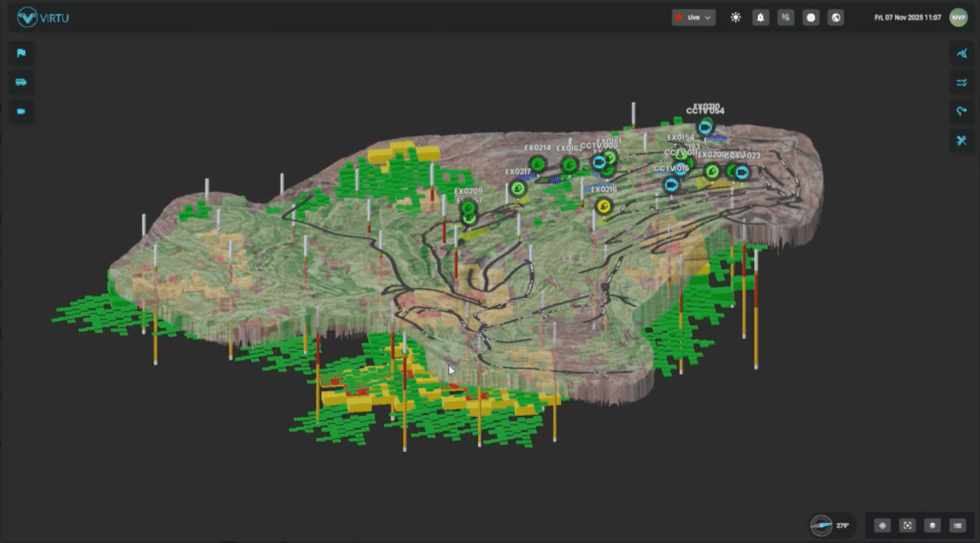
Virtu’s digital twin page describes a feature for mining sites in which average road speed is colour-coded in green, yellow or red. This highlights road sections where trucks move more slowly than expected or where speed may indicate a safety concern.
Speed data usually comes from GPS positions recorded by the Fleet Management System. By calculating average speeds for each road segment and displaying them on the 3D terrain, the digital twin turns raw position data into a map that can be read quickly.
Possible reasons for low average speed on a segment include:
- poor road surface or potholes
- steep grades
- tight curves
- congestion at an intersection or loading point
- wet conditions
High speeds in certain areas, such as near intersections or work zones, may also need attention.
Identifying Congestion
Virtu’s page also describes observing truck movement to identify congestion. In a digital twin, the positions of all trucks are shown together on the terrain. When several trucks are waiting or moving slowly in one place, the cluster becomes visible.
Common congestion points include:
- queues at excavators or loading points
- queues at the crusher or dump
- single-lane sections where trucks must wait for oncoming traffic
- intersections between main haul roads
Seeing congestion in its spatial context helps supervisors decide whether the cause is equipment allocation, road design or a temporary event.
Supporting Faster Decisions
Virtu states that command centres can use the mining digital twin to make tactical decisions faster. For haul roads, examples of decisions that may follow from monitoring include:
- sending a grader or water truck to a specific road section
- adjusting truck allocation between loading units
- temporarily rerouting traffic
- applying or reviewing speed restrictions in certain areas
These decisions remain the responsibility of site personnel. The digital twin provides information to support them.
Historical Review
Virtu’s digital twin includes historical playback and auditing with timestamped replay. For haul roads, this allows teams to review conditions over a past shift or day. Examples include:
- comparing road speeds before and after road maintenance
- reviewing traffic patterns around a reported near miss
- checking how traffic changed after a road was moved
Data Requirements
Effective haul road monitoring in a digital twin depends on:
- regular GPS data from the Fleet Management System
- a current terrain model that shows the actual road network
- defined road segments for calculating average speeds
- agreed speed thresholds for each colour category
Speed thresholds should reflect the site’s own road design, equipment types and traffic rules.
Road segment definitions should also be updated when the road network changes, since haul roads are regularly extended, relocated or closed as the mine develops.
Limitations
A digital twin shows patterns in recorded data. It does not directly measure road surface condition unless additional data, such as inspection records or sensor data, is added. Field inspection by road crews remains necessary.
Summary
A mining digital twin can make haul road speed and congestion visible on a 3D view of the site, supporting earlier action on road and traffic issues. Mining companies interested in haul road monitoring through a digital twin can contact Virtu to discuss their requirements.