Every tactical exercise needs an opponent. In military language this is the opposing force, or OPFOR, and anyone who has organised one knows it is a job in its own right.
A good OPFOR makes an exercise feel real. A tired one, on its fourth repetition before lunch, turns it into a rehearsal. KOMINA offers another option: AI hostile agents that live inside its VR scenarios. This article compares the two approaches without pretending either one wins outright.
What KOMINA AI Hostiles Are
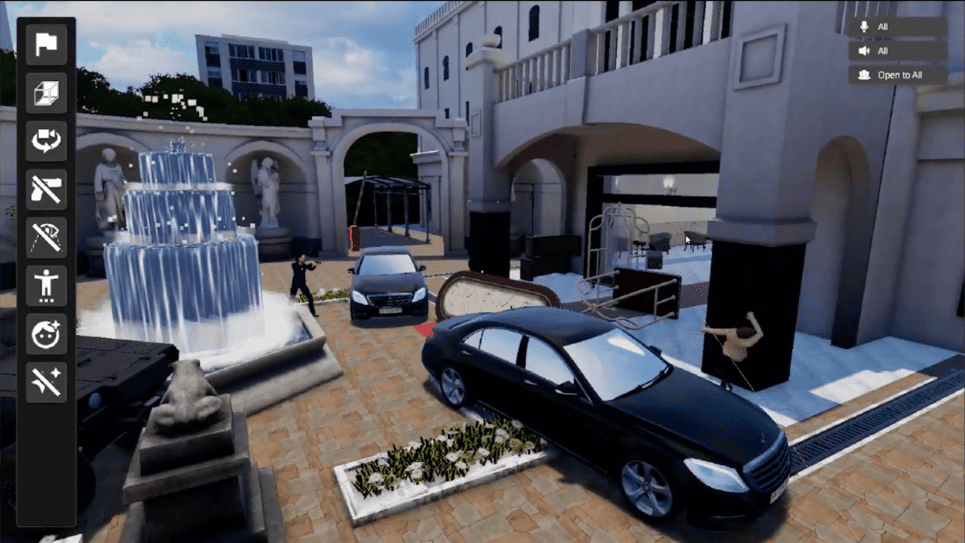
KOMINA describes its hostile agents as armed threats with varying skill levels and tactical awareness. Instructors place them using the NPC spawner in the map editor and give each one a behaviour.
Aggressive hostiles advance and engage directly. Defensive hostiles hold a position and use cover. Ambush hostiles stay hidden until trainees reach a particular spot. Skill level is set separately, so the same building can host an untrained gunman one day and a more capable opponent the next.
They also share the scene with civilians and friendly units, which means a single room can contain an ambush hostile and two compliant bystanders at once.
That combination is what forces a team to identify the threat rather than firing at the first figure it sees. In a crowd scenario, one armed individual can sit among many unpredictable civilians, which is very difficult to stage safely with live role-players.
Where Human Role-Players Are Better
Credit where it is due. An experienced human opponent watches the team, spots its habits and exploits them. If the same officer always enters second and always looks right, a sharp role-player will notice by the third run. AI agents follow the behaviour they were given. They do not learn a team’s weaknesses and come up with new tricks.
Humans also bring improvisation. They talk, bluff, change their minds and do strange things under pressure. For training that depends on negotiation or close physical contact, live role-players remain hard to beat.
Where AI Agents Are Better
Cost and logistics are the obvious points. Human role-players need briefing, protective equipment, safety supervision and often transport and meals. Every hour they spend playing the enemy is an hour they are not training themselves. KOMINA’s homepage lists exactly these issues among the weak spots of traditional training: logistics, slow iteration and costs that do not fall as sessions increase.
Consistency is the less obvious point. Human OPFOR behaviour drifts over a long day. People get bored, settle into the same positions and start going easy. An AI ambush set for one corridor behaves the same way at five in the afternoon as at nine in the morning, which makes before-and-after comparisons fair.
Then there is flexibility. KOMINA’s sandbox allows threat levels to be changed during a session. If a team clears the first floor too easily, the instructor can add a defensive hostile upstairs without stopping the exercise or briefing anyone new.
The Scoring Question
Anyone who has run force-on-force training has heard the argument. “I got you first.” “No, you didn’t.” With people, it is often impossible to settle.
In KOMINA, full-body motion capture records every trainee’s position, posture and shots. Hits on trainees are confirmed physically through the electric shockbelt. The after-action review replays the engagement in 3D and records reaction time, threat identification time, tactical positioning and shot accuracy. Instructors can compare how the same team performed against an aggressive hostile and against an ambush in the same building, and the difference often points to a very specific weakness. Seeing it on the replay tends to settle the argument faster than any amount of discussion.
Using Both
The sensible answer for most units is a combination. AI hostiles handle high-volume, repeatable training: many runs, many variations, the same measurement every time. Live force-on-force exercises with human role-players come later, to test teams against an opponent who adapts.
That split fits how KOMINA describes its own role, as a complement to conventional training rather than a substitute. A unit that wants far more repetitions against a varied opponent, without pulling a dozen people away from their own development each time, will find AI agents a practical tool. The KOMINA team can demonstrate hostile agent setup on request.