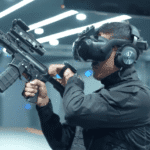
Falls from height remain one of the deadliest hazards in construction and industry, and the cruel thing about training for them is that the one experience that teaches the lesson best — a fall — is the one you can never let happen. So conventional height-safety training tends to stay on the ground: a classroom on harness theory, a poster on the three-point rule, maybe a low platform. It teaches the rules. What it can’t teach is the visceral respect for height that actually changes behaviour. That’s where VR safety training for work at height does something nothing else safely can.
The limit of ground-level training
You can explain a full-body harness, the anchor point, and the inspection checklist in a classroom, and a worker can pass the test. But knowing the rules and feeling why they matter are different things. The discipline of clipping on every single time, checking the harness properly, respecting the edge — that consistency comes from genuinely understanding the consequence, and a slide deck can’t deliver consequence. Under Indonesia’s Permenaker 9/2016 framework for work at height, the competence required is real and specific; the gap is in making it stick.
The result is a familiar failure mode: trained workers who cut corners because the danger feels abstract. The harness goes unclipped “just for a second” because nothing in their training made the height feel real.
What VR adds that the ground can’t
A VR work-at-height scenario lets a worker experience genuine simulated exposure — standing on a structure, looking down, feeling the height — and learn the consequence of a mistake without any real risk. They can practise the harness discipline, the inspection routine, and the careful movement in an environment that actually feels high, so the lessons attach to a real sensation rather than a printed rule.
Indonesian developer VGLANT builds height scenarios on exactly this principle — consequence-based learning, where an unclipped harness or a careless step plays out its result safely in VR. A worker who has felt the height and seen what a shortcut leads to carries a respect for the edge that no classroom instils. That respect is what makes the harness discipline automatic.
Exposure tolerance is trainable
There’s a second benefit: getting workers comfortable operating at height before they’re actually up there. The first exposure to real height is distracting and stressful, and stress at height is dangerous. A worker who has spent time in convincing simulated height arrives at the real structure already acclimatised, able to focus on the task rather than fighting their own nerves.
The honest boundary
VR can’t reproduce the full physical reality of working at height — the real wind, the actual feel of the harness under load, the genuine fatigue. It doesn’t replace hands-on equipment training with a real harness or the supervised real-world experience competence requires. The simulation builds discipline, respect, and tolerance; the physical skills still need physical practice.
But it closes the gap that classroom training never could: making the danger of height real enough to change behaviour, without putting anyone in danger to do it. For a hazard where the first real mistake can be the last, that’s a profound advantage.
You only fall once. VR is how you learn the lesson without paying its price.